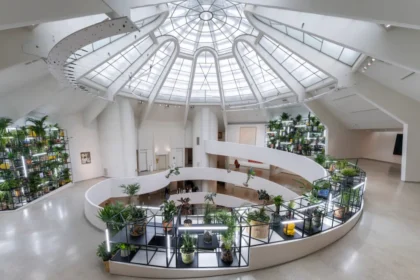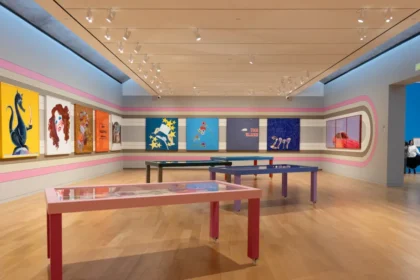


How many artists does it take to change the story of the Arabian Peninsula lands comprising Bahrain, Kuwait, Oman, Qatar, Saudi Arabia, and the United Arab Emirates? About 30, the NYU Abu Dhabi Art Gallery suggests in its inaugural Gulf Quinquennial, and that includes the artist behind the inspired graphic design of its poster, Mohammad Sharaf.
The stipulation is that the curation is exceptionally coherent, and the selection is an efficient array of videos, installations, paintings, and untranslatable traditions of record keeping involving ocean tides. And when I say the show changes the story of the Arabian Peninsula, I mean that it deepens the narrative. The quinquennial tells a story about how no land, especially not the United Arab Emirates, is a cultural monolith. Instead, this show presents the Emirates as an evolving interaction of language and labor, the latter of which is overwhelmingly provided by migrants. Don’t wait; stage such a show in a time of technological upheaval, when morality is flammable and so is the climate.
The show is titled “Between the Tides” and was assembled by executive director and chief curator Maya Allison and Duygu Demir, an art historian who joined the institution in 2023. Allison previously worked with Aisha Stoby on “Khaleej Modern” (2022), an illuminating reintroduction to the players who, in the early 20th century, laid the groundwork for art to be created and shared in the region. Here, Allison and Demir make an equally effective team, creating a five year snapshot of creative practices in the Gulf Cooperation Council (GCC, the official name of the aforementioned countries).
That’s the exact right amount for a recurring show of this kind. In the UAE, a span of five years can see skylines come and go, old and new geopolitical alliances sutured or torn, and new faces on every sidewalk. Not to mention the potential for new art infrastructure: In the 10 years the gallery has been open, Abu Dhabi has welcomed the Louvre, while Dubai has welcomed the Jameel Arts Centre and an expanded gallery district.
A “true” survey of this period, Allison writes in the catalog, “would not be possible in any comprehensive sense.” Rather, “Between the Tides” is told through individuals whose experiences illustrate how a life can unfold across the GCC, as well as the innumerable ways the past and future haunt its present. These artists present the present as both inspiring and menacing.
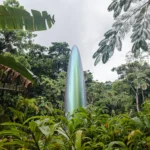
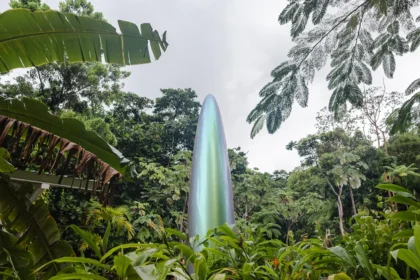
Two works placed early on in the show explore different dimensions of the UAE’s maritime history. The installation Breakers, by the artist Sophia Al Maria, consists of fiberglass and steel structures based on the form of a tetrapod, a concrete block placed in waters to break waves. They resemble monumental playing pieces from the game jacks, though Al Maria’s works are lit from within and stacked like a weary constellation. Despite the UAE’s great stretches of sand, cement, and rock, life here circles the ebb and flow of the Gulf, which flows into the Indian Ocean from the Gulf of Sharjah, and fills lagoons along the coast.

These lagoons have been imperiled for decades by extractive industrial machines. If they go, so do the biosystems that have sustained centuries of local maritime trade, and with them the seafarers who function as repositories for centuries of Indigenous idiosyncrasy and oral tradition. Visual and written histories are relatively new to the Gulf. Consequently, “Past-making,” as one of the exhibiting artists, Christopher Joshua Benton, put it in the press materials, is chief among the gallery’s concerns, and its team directs considerable energy into supporting the creation of publicly accessible, institutional-quality archives. These histories are, by the nature of cultural inheritance, effectively intuitive to their practitioners, meaning this is not knowledge one encounters by chance. Without the intervention of projects such as this, it is fated to die to borrow the show’s title between the tides.
That is why Noor Al-Fayez’s project, Circle No.1: Seasons (2022), is of value. Al-Fayez painted a monumental version of a regional, 365-day calendar that has been used in the Gulf by fishermen, divers, and farmers for centuries. That calendar is resolutely nonintuitive to view it begins with the appearance of the star Suhail, and from there divides the year into four unequal seasons, then splits it even further into 36 “micro seasons” that shift in duration and date according to one’s location in the Gulf. Readings vary further when compared with other local and regional record keepers; the calendar also shares commonalities with Persian systems. Al-Fayez drew her iteration in chalk and layered it with a thick resin glaze, overlaid with additional localizations, drawing extensively from the work of the late Kuwaiti astronomer Saleh Al-Ojairi.
These systems are divorced from Western timekeeping, such as clocks and almanacs, whose origins lie in the Agricultural and Industrial Revolutions. It’s a wonderfully radical notion, speaking as an American, to divorce one’s eventualities from capitalist machinations in favor of the whims of water and wind.
Near Circle No.1: Seasons are two projects that again force encounters with a dimension of the Gulf made invisible by more insidious means: the 30 million migrants, overwhelmingly hailing from South Asian countries, who live in the GCC and make up around 80 percent of the UAE’s population. By design, it is unlikely a tourist from the so-called Global North will spend any considerable time in migrant spaces—mainly malls, grocery stores, or what artist Christopher Joshua Benton calls “bed spaces” given the region’s intense cultural and economic stratification.

In text accompanying the exhibition, Benton defines a “bed space” as a site limited to a “single bed and its immediate vicinity, a cost-effective housing practice for low-income workers.” Called Chirag’s Things, after the Indian master tailor who met the artist as a relative newcomer to Dubai, his work is a lucite box made to the dimensions of the UN’s formula for overcrowding 100 centimeters square and bloated with clothing, toiletries, medicine, bedding, dish soup, and cutlery. These disposables press against their confines, this metaphorical coffin; it’s ghastly to realize room must be impossibly made for a body. Art institutions are powerful, I think, because of their capacity to redistribute value across materials and people. Benton, in a particularly generous gesture, has transmuted Chirag’s “things” into relics.
The inverse of this institutional power is its capacity to return relics to their things, reminding us that the past is present. This temporal alchemy is at work in Gauze (2023) by Hazem Harb, an artist who typically works in photocollage but, in the final months of 2023, turned to a paper-making technique he learned in Italy. Harb worked the pulp of cardboard cartons into paper the color of his skin and then, with archival adhesive, sculpted the gauze onto the board. Gauze, as the material’s state, finds its etymology in Harb’s Gaza, and its sonic resonance stirs and shames like all important things gone unnoticed. Harb arranged the fibers within each frame in an intentional sequence to suggest time passing. Fibrous limbs reach beyond their confines only to fall, as if beaten from above, ripping to rise again; finally, funeral veils escape on the breeze.
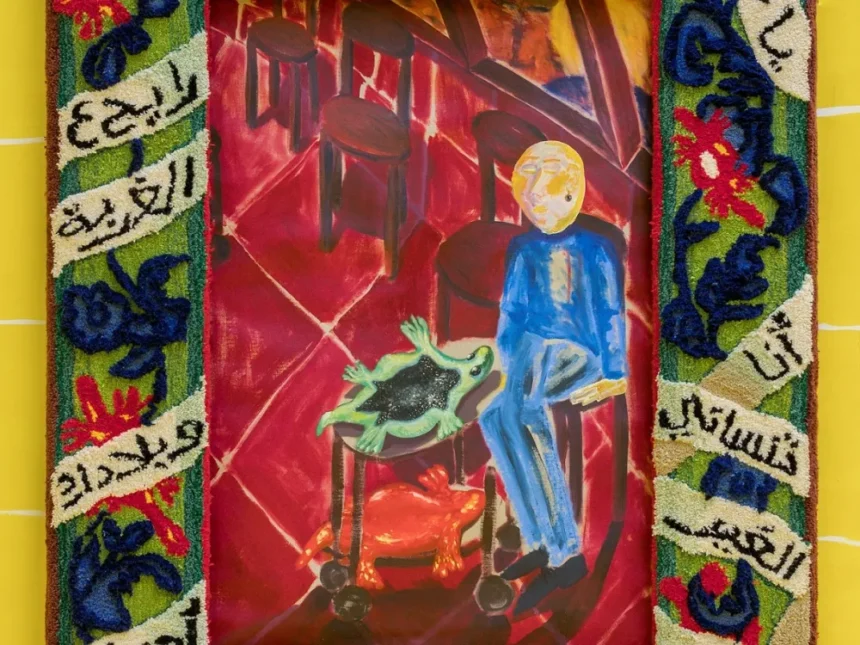
It’s a good time for both old and new biennials in the region, such as the Sharjah Biennial, on view one Emirate over, to reconsider their approach to exhibition making. The climate can’t sustain the prevalent biennial model given the volume of people and work it supports, and the ease with which they rationalize their exponential growth. Get a copy of this catalog, as the show will soon close. Check out Vikram Divecha’s El Dorado (2022), named after a now-defunct movie theater in Abu Dhabi that screened South Asian films. The story of this venue is told through the diary of the theater’s projectionist, “K,” a bored introvert who made paintings and drawings that reflected his peculiar position: a particularly invisible member of an invisible class and as the facilitator in a ritual of social gathering.
Preserved among K’s diary pages are clippings from a scanned 1982 article from the newspaper, the League Times Daily, about an anti government strike in India, suggesting that K attended that very demonstration, briefly casting him in the cast of his own epoch. He gave the El Dorado another story; us as well.