

There’s a specific kind of friction at the center of Lib Mason’s painting practice: a technique developed centuries ago, deployed to address subjects that are unmistakably of this moment. That friction isn’t accidental. It’s the entire engine of her work.
The Technique, Explained
Mason paints in oil using the Flemish technique, a method associated with Northern European Old World painting. Every piece begins with a grisaille, a monochrome underpainting used to resolve form, value, and light before color enters the composition at all. From that foundation, she builds the image through successive transparent glazes, allowing color and luminosity to accumulate slowly over multiple layers rather than arriving in a single application. It’s a process that prizes depth, luminosity, and controlled development over speed, the visual signature of Renaissance and Flemish painting, in which light appears to emerge from within the panel rather than sit on its surface.
Mason didn’t arrive at this technique straight out of school. She studied editorial illustration at the Rhode Island School of Design, then spent years as a commercial illustrator, creating work for major publications including Rolling Stone and Time Life Warner, and later expanding into product development and artist-branded licensed lines. That career was, by nature, built for speed and immediacy: images made to communicate quickly, on deadline, for a client’s specific need. Her turn toward the Flemish method, adopted roughly eight years ago when she stepped away from commercial work, represents something close to a technical reversal, a deliberate slowing down.
Old Language, New Subjects
What makes Mason’s practice distinct isn’t just her use of a historical technique; it’s what she uses it to say. Renaissance and Flemish painting traditions were often employed for religious, mythological, or aristocratic subjects. Mason redirects that same visual language toward contemporary political, social, and environmental events, the kind of material typically associated with photojournalism or protest art, not glazed oil panels.
She isn’t interested in illustrating these events literally. Instead, her artist statement points to beauty, symbolism, humor, and absurdity as her chosen tools, a way of placing contemporary subject matter inside a historical visual grammar, so that the painting’s surface and its content seem to be operating in two different centuries at once.
Case Studies in Collision
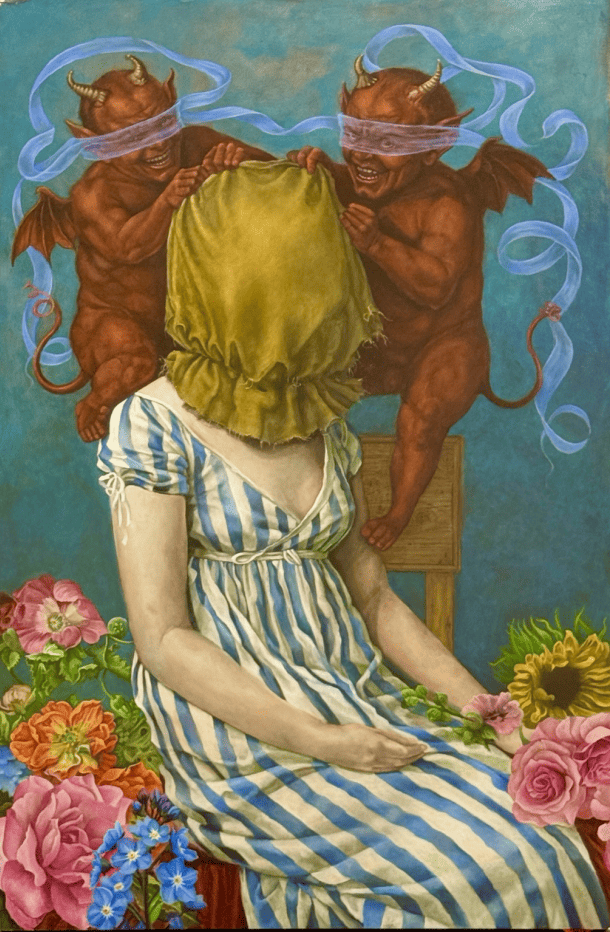
RIP ICE makes this collision explicit. Painted in response to the shooting of Renee Good, the composition, two grinning, blindfolded devils pulling a hood over a seated woman, surrounded by brilliant color and flowers, borrows the compositional confidence and glowing surface of Old World painting to depict a distinctly contemporary act of violence. The woman’s skin, painted chalky, pale, and uneven, resists any specific racial or personal identity, allowing her to stand in universally. The devils’ blindfolds point to a very current anxiety: power exercised without truly seeing the individual in front of it.
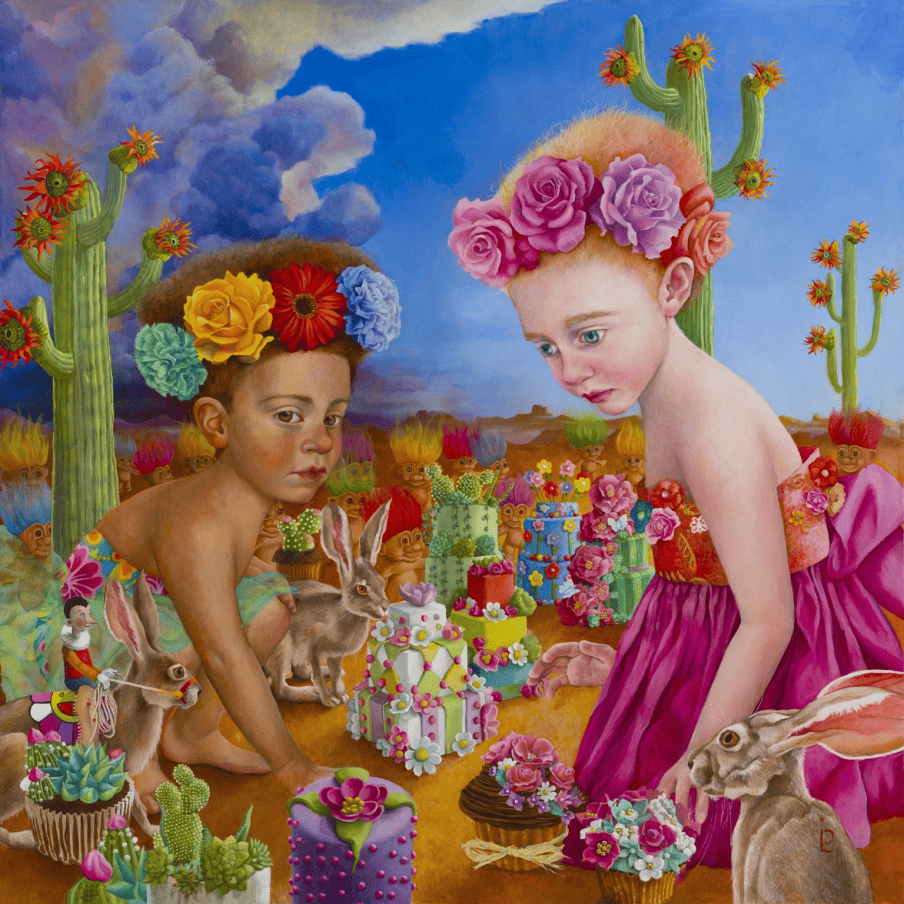
Esparza, Nadine and the Beautiful Wall takes on one of the more literal pieces of contemporary political architecture, the wall built between Mexico and the United States, and translates it into an invented, almost fable-like scene. Two young girls build their own wall out of cakes, meant to keep out trolls rather than people, while Pinocchio looks on as a witness to a world where distinguishing truth from lies has become difficult. The shift from concrete and steel to cake, and from adults to children, filters a modern political flashpoint through the visual and narrative conventions of allegory, a mode with deep roots in the same painting traditions Mason’s technique draws from.
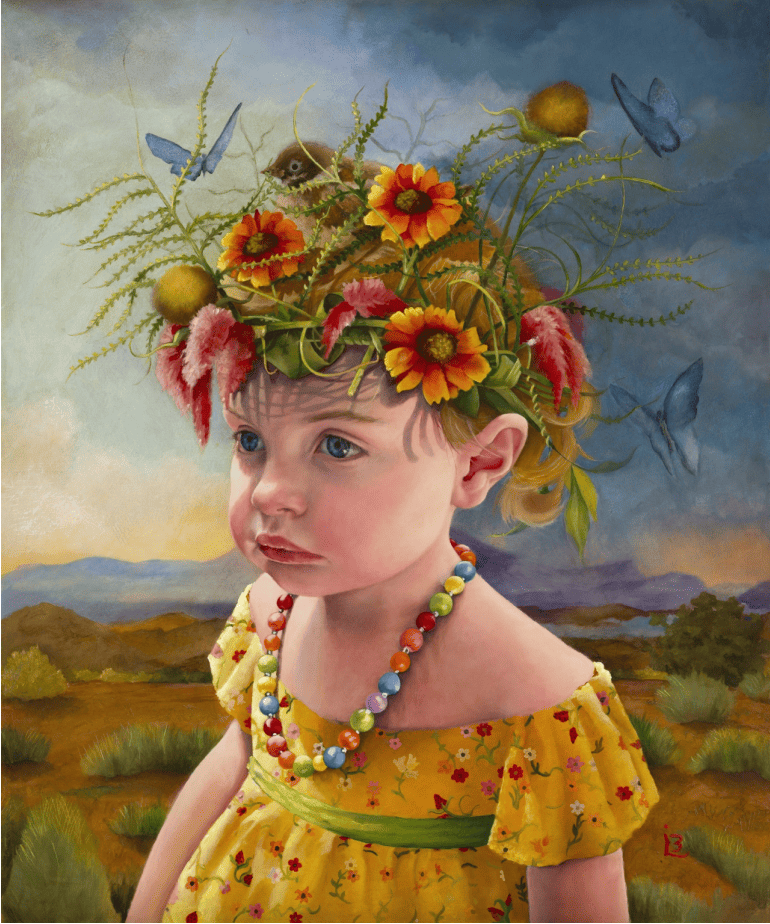
Flight is quieter but no less contemporary in its concern. A young girl stands alone in a barren landscape, a composition that owes its restraint and glow to the same glazing process used throughout Mason’s work, applied here to ask an unmistakably present-day question: what kind of planet are we leaving to the next generation?
Why the Collision Works
The friction between Mason’s historical method and her contemporary subjects isn’t a gimmick. It does real interpretive work. A technique built for patience and gradual revelation forces both painter and viewer to slow down around material that usually moves at the speed of a news cycle. By placing today’s anxieties inside centuries-old visual language, Mason creates paintings that feel simultaneously familiar and disorienting, beautiful the way an altarpiece is beautiful, unsettling the way a headline is unsettling, and entirely her own where those two things meet.
Explore more of Lib Mason’s contemporary oil paintings and exhibition updates at libmasonartist.com. To see her traditional Flemish glazing process in action, follow @libmason5687on Instagram.