

Identity is never fixed. Every memory, relationship, emotion, and life experience quietly reshapes the person we become, creating a continuous process of transformation that often goes unnoticed. For Renata, this evolving nature of human existence forms the foundation of her artistic practice. Through expressive acrylic paintings, she investigates the fluid relationship between identity, emotion, and time, creating figurative works that invite viewers to reflect on their own personal journeys. Rather than portraying people as permanent or complete, Renata presents the human figure as something constantly changing—an image of becoming rather than simply being.
At the heart of Renata’s work lies a fascination with transformation. She views identity not as a stable characteristic but as a living process influenced by every experience, encounter, and emotional response throughout life. Every conversation, moment of joy, disappointment, challenge, or discovery leaves an invisible mark, gradually shaping the way individuals perceive themselves and the world around them. Her paintings seek to make these invisible changes visible through the language of contemporary art.
Working primarily with acrylic paint, Renata has developed a visual style that reflects the fluidity of human existence. Acrylic offers both versatility and immediacy, allowing her to build delicate layers, soften edges, and create subtle transitions that mirror the shifting nature of identity itself. Through careful manipulation of color, transparency, and texture, she creates compositions that feel simultaneously tangible and elusive.
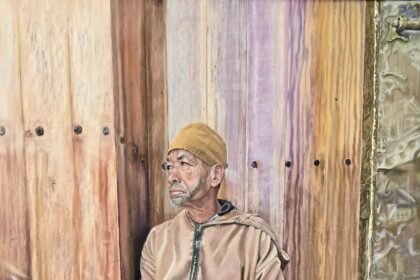
The human figure occupies a central place in her artistic language. Rather than depicting individuals with photographic precision, Renata approaches the body as a symbolic form capable of expressing emotional and psychological transformation. Her figures become visual metaphors for personal evolution, representing the countless ways people grow, adapt, and redefine themselves over time.
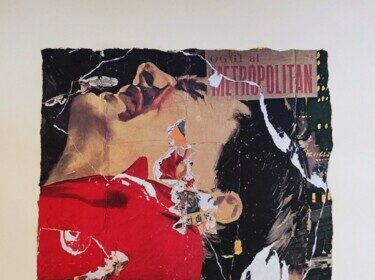
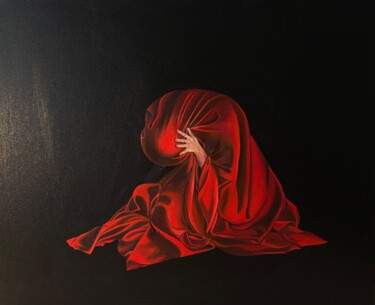
One of the defining characteristics of her work is the treatment of the figure as something intentionally unfinished and constantly evolving. Faces and bodies often appear partially obscured, blurred, or dissolving into their surroundings. These visual choices are not meant to conceal identity but to emphasize its changing nature. By avoiding rigid definition, Renata reminds viewers that identity cannot be confined to a single image or permanent state.
This sense of impermanence extends throughout her compositions. Figures may seem to emerge from mist-like layers, disappear into soft washes of color, or exist somewhere between presence and absence. The boundaries separating body and space become fluid, suggesting that the self is continually influenced by both internal emotions and external experiences. Every painting captures a temporary moment within an ongoing process rather than a final destination.
The concept of balance is equally important within Renata’s work. She is particularly interested in the delicate relationship between stability and transformation, permanence and impermanence, certainty and uncertainty. Her paintings explore these opposing forces without attempting to resolve them, instead allowing them to coexist naturally within the same visual space. This tension gives her work both emotional depth and philosophical resonance.
Emotion often takes precedence over literal representation. Rather than illustrating specific narratives or identifiable individuals, Renata creates atmospheres that encourage viewers to respond intuitively. Her paintings invite emotional recognition rather than factual observation, allowing each person to discover meanings shaped by their own memories and life experiences. In this way, every encounter with her work becomes deeply personal.
The blurred quality present in many of her figures carries particular symbolic significance. Instead of representing confusion or loss, these softened forms acknowledge that identity is always in motion. Human beings continuously evolve through relationships, environments, successes, failures, and personal reflection. By refusing to define her subjects too precisely, Renata celebrates this ongoing process of growth rather than presenting identity as something fixed or complete.
Veils, translucent layers, and shifting contours further reinforce this visual philosophy. These elements create an impression of movement even within still compositions, suggesting that the emotional life of every individual continues beyond the moment captured on the canvas. What appears visible on the surface is only one layer of a much deeper inner experience.
Color also plays an essential role in communicating emotional transformation. Rather than functioning purely as decoration, carefully balanced palettes contribute to the psychological atmosphere of each painting. Soft transitions, muted harmonies, and occasional moments of stronger contrast create visual rhythms that echo the complexity of human feeling. Through color, Renata gives emotional experiences a tangible visual presence.
Texture contributes another layer of meaning to her work. Multiple applications of acrylic paint produce surfaces that reveal traces of previous gestures, much like human identity carries the imprint of past experiences. Layers become visual metaphors for memory itself, suggesting that every stage of life remains quietly embedded beneath the present moment.
One of the most compelling aspects of Renata’s artistic practice is the dialogue she creates between the physical and the emotional. Her paintings exist within this liminal space, where visible forms become vehicles for invisible experiences. Rather than separating body and mind, she presents them as inseparable aspects of the same evolving identity. Every gesture, posture, and surface treatment contributes to this subtle conversation.
Her work also encourages viewers to reconsider their own understanding of identity. In a world that often demands certainty and clearly defined roles, Renata’s paintings propose a different perspective—one that embraces change as a natural and necessary part of being human. Transformation is not portrayed as something to fear but as the very essence of personal growth.
Rather than providing fixed interpretations, her paintings remain intentionally open. Every viewer brings unique memories, emotions, and perspectives that shape the meaning of each artwork. This openness reflects Renata’s belief that art becomes most powerful when it invites participation rather than offering predetermined conclusions. Each painting becomes a shared space where artist and audience meet through reflection and emotion.
Today, Renata continues to develop a contemporary artistic practice centered on the exploration of identity, impermanence, and emotional experience. Through expressive acrylic paintings, she transforms the human figure into a symbol of continual becoming, reminding viewers that change is not an interruption of life but one of its defining characteristics. Her work celebrates the beauty found within uncertainty, revealing that personal transformation is not a destination but an endless journey shaped by every moment we live.
By combining figurative imagery with poetic abstraction and emotional sensitivity, Renata has created an artistic language that speaks quietly yet profoundly about what it means to be human. Her paintings invite us to pause, reflect, and recognize ourselves not as finished identities, but as living stories that continue to unfold with every experience, every encounter, and every passing moment.