

Contemporary painting often serves as a mirror for personal experience, cultural reflection, and emotional exploration. For Elisa De Montis, art is a means of examining the complex relationship between identity, nature, and the unseen forces that shape human life. Through richly symbolic oil paintings, the Italian artist creates poetic figurative compositions where women, plants, and dreamlike imagery merge into visual narratives that invite contemplation. Her work occupies the space between reality and imagination, transforming the canvas into a place where psychology, mythology, and the natural world coexist.
Born in Italy in 1993, Elisa De Montis developed her artistic voice through an independent path. As a self-taught painter and artisan, she cultivated her practice through continuous experimentation, observation, and personal study rather than formal academic training. This freedom allowed her to develop an artistic language that remains deeply personal, unconstrained by conventional expectations and guided instead by intuition, symbolism, and emotional authenticity.
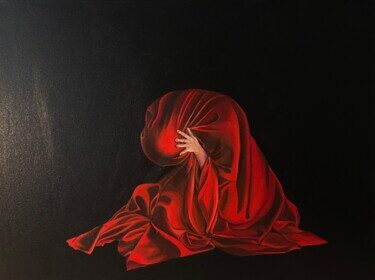
From the beginning of her career, De Montis has been drawn to figurative painting, using the human body as one of her primary vehicles for expression. Rather than pursuing realism alone, she employs the figure as a symbolic presence capable of conveying emotional and psychological states. Every posture, gesture, and expression contributes to a broader visual narrative that extends beyond physical appearance, encouraging viewers to consider the inner world of her subjects.
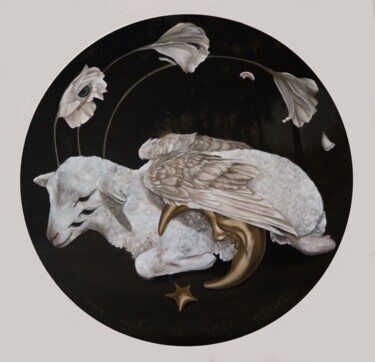
Her paintings are distinguished by a strong symbolist sensibility, where familiar forms are enriched through metaphor and layered meaning. Flowers, leaves, branches, animals, and natural elements frequently accompany her figures, creating visual relationships that suggest transformation, memory, vulnerability, and renewal. These symbols are never merely decorative; they function as essential components of a carefully constructed emotional landscape.
Alongside symbolism, surrealist influences play an important role in her work. Dreamlike settings, unexpected juxtapositions, and imaginative compositions blur the boundaries between reality and fantasy. Rather than presenting logical narratives, De Montis allows intuition and subconscious imagery to shape her paintings, inviting viewers to interpret each work according to their own emotions and experiences. This openness gives her art a timeless and universal quality.
A significant chapter in her artistic development came through the years she spent living in Spain. Immersing herself in a different cultural environment broadened her perspective and strengthened her interest in the concept of freedom, particularly in relation to women’s identities and roles in contemporary society. The experience inspired a renewed artistic vision that continues to shape her work today.
The representation of women has become one of the central themes throughout De Montis’s career. Rather than portraying women as passive figures or symbols of sacrifice, she seeks to reclaim and reimagine their place within visual culture. Her paintings move beyond traditional narratives of suffering, presenting women instead as powerful, autonomous, and deeply connected to mythological and symbolic traditions.
This transformation reflects one of her long-term artistic philosophies. Female figures in her work often appear as guardians of ancient wisdom, embodiments of nature, or mythic beings whose strength emerges from their connection with both the visible and invisible worlds. Through these representations, De Montis challenges historical stereotypes while celebrating resilience, intuition, and creative power.
Nature occupies an equally essential place within her artistic universe. A passionate gardener, she has developed a profound appreciation for plants, flowers, and the rhythms of the natural world. This personal relationship with nature extends directly into her paintings, where botanical imagery becomes an expressive language linking humanity to the broader cycles of life.
Floral and plant symbols recur throughout her work as visual metaphors for growth, transformation, fertility, and renewal. They establish a meaningful dialogue between woman as the generator of life and Mother Nature as the creator of worlds, emphasizing the interconnectedness of human existence and the environment. Rather than separating people from nature, De Montis portrays them as inseparable elements within the same living system.
Balance is another recurring concept within her paintings. She explores the fragile boundary between external reality and the hidden emotional landscapes that exist within every individual. Light and shadow, order and instinct, beauty and uncertainty coexist throughout her compositions, reflecting the constant tension between what society expects and what human emotions genuinely express.
This psychological dimension transforms her paintings into what can be described as a theater of the mind. Every canvas becomes a stage where internal conflicts, memories, desires, and fears unfold through symbolic imagery. Social expectations often confront spontaneous emotion, creating visual narratives that examine the complexity of personal identity and emotional freedom.
Rather than offering definitive answers, De Montis invites viewers to participate in this psychological exploration. Her paintings encourage quiet reflection, allowing each observer to discover individual meanings within the symbolic forms. The experience becomes deeply personal, shaped by the memories, emotions, and interpretations each viewer brings to the artwork.
Continuous learning remains fundamental to her creative practice. De Montis views painting not simply as a means of producing images but as a lifelong process of understanding the world. Every new work becomes an opportunity to investigate human behavior, mythology, symbolism, and the relationship between inner experience and external reality. This commitment to ongoing study ensures that her artistic language continues to evolve while remaining faithful to its central themes.
Technically, her preferred medium of oil painting supports this layered approach. The richness and versatility of oil paint allow her to build luminous surfaces, subtle transitions, and intricate details that reinforce the emotional atmosphere of each composition. Carefully balanced colors and refined textures contribute to works that feel both intimate and immersive.
Today, Elisa De Montis continues to develop a distinctive artistic practice rooted in symbolism, femininity, and the natural world. Her paintings celebrate the strength of women, the mystery of myth, and the profound connections linking humanity to nature. By combining figurative realism with surreal imagination and psychological depth, she creates artworks that transcend simple representation, offering viewers an opportunity to reflect on their own inner landscapes.
Through her thoughtful exploration of identity, emotion, and the invisible threads that unite all living beings, Elisa De Montis has established a compelling voice within contemporary figurative painting. Her work reminds us that art can serve not only as a reflection of the world around us but also as a guide toward understanding the hidden dimensions of ourselves, where myth, memory, and nature continue to shape the human experience.