

Few artists transformed the visual language of post-war art as radically as Mimmo Rotella. By tearing, layering, and reassembling advertising posters taken directly from city streets, he challenged traditional ideas of painting while redefining the relationship between art and everyday life. Best known for pioneering the technique of décollage, Rotella became one of the leading figures of the Nouveau Réalisme movement, creating works that reflected the rapidly changing urban culture of the twentieth century. His innovative practice elevated ordinary materials into powerful artistic statements, exploring themes of mass media, consumer culture, memory, and the fleeting nature of modern society.
Born Domenico Rotella on October 7, 1918, in Catanzaro, Italy, the artist grew up during a period of profound social and political change. From an early age, he demonstrated an interest in both visual art and literature, interests that would later shape the intellectual depth of his artistic practice. His formal education included studies in Naples, where he developed a solid understanding of traditional artistic techniques before gradually embracing more experimental forms of expression.
Like many artists of his generation, Rotella initially worked in figurative painting, exploring conventional methods of representation. However, the rapidly evolving artistic landscape of the post-war era encouraged him to question established traditions. Influenced by the growing avant-garde movements across Europe, he began searching for a visual language capable of expressing the complexity, energy, and contradictions of contemporary urban life.
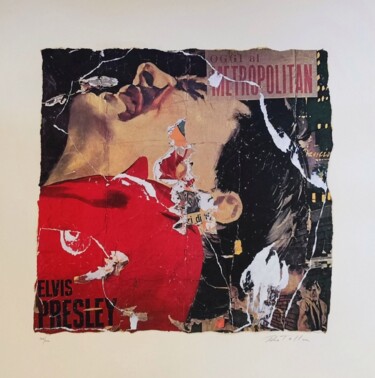
This search led to one of the most significant breakthroughs in his career. During the early 1950s, Rotella developed the technique that would become synonymous with his name: décollage. Unlike collage, which involves assembling different materials onto a surface, décollage works by removing layers. Rotella collected advertising posters from city walls and carefully tore away portions of them, revealing hidden images, colors, and typography beneath the surface. The resulting compositions were rich with texture, fragmentation, and unexpected visual relationships.
The streets themselves became his studio. Instead of purchasing traditional art materials, Rotella found inspiration in weathered billboards, torn movie posters, commercial advertisements, and public announcements. Every poster carried traces of urban life—layers of history created by time, human interaction, and constant renewal. By bringing these fragments into galleries and museums, he transformed the overlooked visual landscape of the city into contemporary art.
His décollage works captured the rhythm of modern society in a way that few artists had attempted before. Torn paper, overlapping advertisements, fading colors, and fragmented lettering reflected the constant flow of information surrounding everyday life. Rather than presenting polished or idealized images, Rotella embraced imperfection, allowing the accidental beauty of damaged posters to become an essential part of the artistic composition.
One of the defining characteristics of his work was its engagement with consumer culture. During the post-war economic boom, cities became increasingly saturated with advertising, cinema posters, commercial branding, and mass media imagery. Rotella recognized these materials not merely as advertisements but as cultural documents that revealed society’s desires, aspirations, and obsessions. His art examined how visual communication shaped public consciousness while questioning the temporary nature of fame, fashion, and commercial success.
Typography played an equally important role in his compositions. Fragments of words, slogans, and headlines often appeared alongside images of celebrities, films, and consumer products. These incomplete texts encouraged viewers to construct their own narratives while emphasizing the fragmented nature of contemporary communication. Meaning emerged not from complete messages but from the interaction between visual elements and personal interpretation.
In 1960, Rotella became closely associated with Nouveau Réalisme, an influential artistic movement founded by French critic Pierre Restany. The group brought together innovative artists such as Yves Klein, Arman, and Jean Tinguely, all of whom sought to erase the boundaries between art and everyday experience. Rather than distancing themselves from modern society, these artists embraced urban life, industrial materials, consumer products, and mass media as legitimate artistic resources.
Rotella’s décollage practice perfectly embodied the ideals of Nouveau Réalisme. His use of found materials reflected the movement’s belief that contemporary reality itself could become artistic material. Instead of inventing fictional imagery, he worked directly with the visual environment created by modern cities, transforming familiar objects into thought-provoking works of art. Through numerous international exhibitions alongside fellow members of the movement, Rotella helped establish Nouveau Réalisme as one of the defining artistic developments of the post-war period.
Although décollage remains his best-known contribution, Rotella continually experimented with new techniques throughout his career. One such approach was retro d’affiches, where he explored the reverse sides of posters, revealing unexpected textures, marks, and material qualities often hidden from public view. This process shifted attention away from printed imagery toward the physical character of the poster itself, expanding his investigation into the material nature of visual communication.
Another important technique was effacage, or erasure. Instead of tearing posters apart, Rotella partially removed images or text, creating compositions where absence became as significant as presence. These works reflected his continuing fascination with transformation, memory, and the changing meanings that emerge when familiar images are altered or obscured.
As technology, advertising, and media evolved during the second half of the twentieth century, Rotella’s work evolved alongside them. His artistic practice remained remarkably adaptable, responding to new visual cultures while preserving his commitment to experimentation. Whether working with cinema posters, commercial advertisements, or popular imagery, he consistently explored the relationship between art, society, and communication in an increasingly image-driven world.
Throughout his long career, Rotella exhibited extensively across Europe and internationally, earning recognition as one of Italy’s most innovative contemporary artists. Critics and collectors admired not only the originality of his techniques but also the intellectual depth behind his work. By transforming discarded urban materials into significant works of art, he demonstrated that creativity could emerge from the most ordinary aspects of everyday life.
Mimmo Rotella passed away on January 8, 2006, leaving behind a remarkable artistic legacy that continues to influence generations of contemporary artists. His pioneering exploration of décollage expanded the possibilities of modern art while encouraging viewers to reconsider the visual environment surrounding them. Long before street art and urban interventions became widely recognized, Rotella understood that city walls contained stories worth preserving.
Today, his works remain celebrated in major museums and private collections around the world. More than technical innovations, they stand as enduring reflections on consumer culture, media, identity, and the constantly changing landscape of modern society. Through torn posters, layered surfaces, and fragmented imagery, Mimmo Rotella transformed the overlooked remnants of everyday life into timeless works of art, securing his place as one of the most influential figures in post-war European art.