

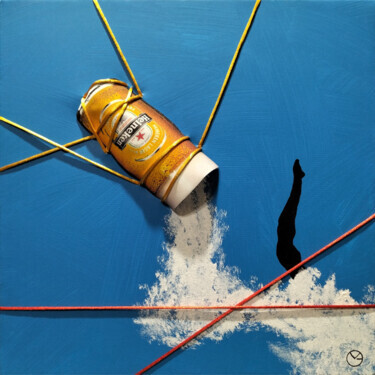
Artistic evolution is rarely a straight path. For many artists, it unfolds through years of experimentation, shifting influences, and an ongoing search for a visual language that truly reflects their inner world. This spirit of exploration defines the career of Gio Mondelli, a contemporary Italian artist whose work has continually evolved through diverse styles, techniques, and artistic philosophies. From his early academic training to his mature expressionist landscapes, Mondelli has built a body of work driven by curiosity, emotional depth, and an unwavering commitment to creative discovery.
Born and raised in Italy, Gio Mondelli developed an early fascination with visual art that eventually led him to pursue formal studies at the LABA Free Academy of Fine Arts. The academy provided an environment where technical skills, creative experimentation, and critical thinking could flourish together. During these formative years, Mondelli refined his understanding of drawing, composition, color, and artistic theory while laying the foundations for the distinctive creative identity that would emerge over time.
Although academic training offered valuable technical knowledge, Mondelli never viewed education as the end of his artistic development. Instead, it became the beginning of a lifelong process of experimentation. Rather than settling into a single style, he remained determined to explore multiple artistic directions, believing that every technique and movement could contribute something meaningful to his own visual language.
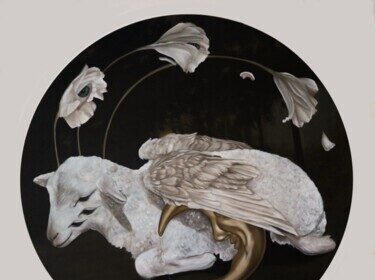
In the early stages of his career, Mondelli became particularly interested in the worlds of Symbolism and Surrealism. These influential artistic movements encouraged him to move beyond literal representation and investigate the psychological, philosophical, and emotional dimensions of painting. Instead of depicting reality exactly as it appeared, he sought to reveal the hidden meanings, dreams, and subconscious experiences that exist beneath the surface of everyday life.
The influence of Symbolism can be seen in his attention to metaphor, atmosphere, and emotional resonance. His compositions often suggest narratives without fully explaining them, inviting viewers to interpret visual elements according to their own imagination and experiences. Every image becomes an open conversation between artist and audience rather than a fixed statement.
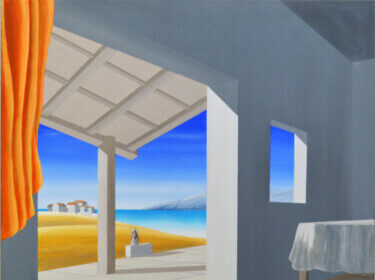
Surrealist ideas further expanded his creative possibilities. Dreamlike environments, unexpected visual relationships, and poetic ambiguity introduced a sense of mystery into his work. Rather than relying solely on realism, Mondelli embraced the freedom to combine reality with imagination, creating compositions that encourage reflection on both the visible world and the inner landscape of the human mind.
As his artistic journey continued, Mondelli explored a variety of additional styles, demonstrating remarkable versatility. For a period, he devoted himself to classical painting, studying traditional approaches that emphasized balance, craftsmanship, and technical precision. This exploration strengthened his understanding of structure, form, and composition while deepening his appreciation for the rich history of European painting.
He also turned his attention to the Macchiaioli, the nineteenth-century Italian movement celebrated for its expressive use of light, color, and tonal contrast. Their emphasis on direct observation and atmospheric effects resonated with Mondelli’s growing interest in landscape painting. At the same time, he experimented with hyperrealism, developing technical control that allowed him to capture extraordinary levels of detail and visual accuracy.
Yet despite mastering these different approaches, Mondelli continued to feel an inner restlessness that prevented him from remaining within any single artistic framework. This constant desire to evolve became one of the defining characteristics of his career. Personal experiences, including the emotional challenges of his childhood, encouraged him to seek forms of expression capable of communicating deeper psychological truths rather than external appearances alone.
This search ultimately led him toward Expressionism, where he discovered a more authentic and emotionally direct artistic voice. Expressionism offered the freedom to prioritize feeling over realism, allowing color, brushwork, and composition to become powerful vehicles for emotion. Rather than reproducing landscapes exactly as they appear, Mondelli began interpreting them through memory, intuition, and personal experience.
Landscape painting has since become one of the defining features of his artistic practice. However, his landscapes extend far beyond traditional representations of nature. They function as emotional environments, reflecting internal states as much as physical locations. Mountains, forests, skies, rivers, and open horizons become symbolic spaces where memory, solitude, hope, and contemplation coexist.
Color plays a particularly important role in these compositions. Rather than simply describing the natural world, Mondelli uses carefully orchestrated palettes to establish mood and emotional atmosphere. Bold contrasts, subtle tonal transitions, and expressive brushstrokes transform familiar scenery into deeply personal visual experiences, inviting viewers to connect with the emotional qualities of each landscape.
His paintings also reveal an impressive balance between technical discipline and creative freedom. The knowledge acquired through years of studying classical traditions, Symbolism, Surrealism, and realism continues to inform his work, while expressionist techniques allow spontaneity and emotion to shape the final composition. This combination gives his paintings both structural strength and emotional immediacy.
Throughout his career, Gio Mondelli has presented his work at numerous important exhibitions and artistic events, where his paintings have attracted the attention of respected critics and collectors. Recognition from the art community reflects not only his technical ability but also the originality of his artistic vision. His willingness to evolve while remaining faithful to his personal voice has earned him a distinctive place within contemporary Italian painting.
His reputation extends well beyond Italy. Today, Mondelli’s paintings are held in private collections across Belgium, Germany, France, and the United States, demonstrating the international appeal of his work. Collectors from diverse cultural backgrounds are drawn to the emotional universality of his paintings, which speak through atmosphere, color, and expressive composition rather than relying on literal narratives.
What makes Gio Mondelli’s work particularly compelling is his refusal to remain artistically static. Every stage of his career has been shaped by curiosity, experimentation, and a sincere desire for personal growth. Rather than repeating established formulas, he continually challenges himself to explore new ideas while remaining connected to the emotional core that defines his artistic practice.
Today, Gio Mondelli continues to develop a body of work that reflects both technical mastery and profound emotional sensitivity. His paintings demonstrate that artistic evolution is not about abandoning the past but integrating every experience into an ever-expanding creative vision. Through expressive landscapes, symbolic imagery, and a lifelong commitment to exploration, he invites viewers to look beyond appearances and discover the emotional landscapes that unite memory, imagination, and the natural world.
As a contemporary Italian artist, Mondelli represents the enduring power of painting as a medium for personal expression and human connection. His work stands as a reminder that the most meaningful artistic journeys are those driven not by certainty, but by the courage to continually search, question, and create.