

Winter exhibitions from CAC Brétigny to Le Crédac
ACROSS FRANCE, the far right is consolidating its hold on elected offices, fascistic language spreads like wildfire in both local and national media, and cultural budgets have been frozen, if not cut altogether. Against these prevailing headwinds, or perhaps in response to them, this season’s institutional exhibitions in Paris have been leaning heavily into various forms of collaboration, mutual learning, and dialogue. A collegial atmosphere is particularly palpable around the Île de France region, among its network of centres d’art. These public, noncollecting institutions, akin to Germany’s kunstvereine, were for the most part founded in the 1980s and ’90s to bring art directly to a “periphery” of small towns, schools, or distant suburbs. In the Paris area alone, over a dozen art centers dot the city, from Paris’s thirteenth arrondissement (Bétonsalon) to the suburb of Brétigny sur Orge (CAC Brétigny). These venues are known for hosting exhibitions and organizing public programs with some of the most promising artists of the moment, often presenting shows that might prove too experimental for a museum, or featuring artists working in media (performance, installation, video) that may not be particularly attractive to the market.

In the town of Houilles, just west of Paris, La Graineterie is a city-run art center recognized for its Biennale de la jeune création (Biennial of Emerging Art), a project that has focused on exhibiting emerging French artists since 1997. Its regular exhibition programming also continues this mandate; guest curator Clément Raveu’s exhibition, titled “ça parle en douce” (loosely translatable as “speaking quietly”), features work by a new generation of artists including Parisa Babaei, Rafael Moreno, Hatice Pinarbaşi, and Manoela Prates, all of whom are exploiting the slippages to be found between spoken, visual, and written language.
One entered the art center via a covered courtyard (La Graineterie was originally a farm, complete with individual stalls for now long gone horses), where the Paris-based Pinarbaşi is showing large scale installations that include mattresses, rugs, and paintings dotted with embroidery, writing, brushstrokes, and pendants both large and small, encouraging close looking from visitors that often demanded that they stoop down to floor level in order to view the many clues. The artist, who is Kurdish Alevi, includes phrases and words in languages including Turkish, French, and Kurmanji the last of which has long been repressed by Turkish, Syrian, and other state authorities yet is commonly spoken among the Kurdish diaspora, often relegated to domestic spaces, away from unfriendly public ears. The installations double as a kind of lounge, and with them Pinarbaşi highlights the more informal, intimate, and private registers in which art, much like spoken languages, also circulates. On an elevated platform nearby, Prates’s costumed figures, Menina, Urubu, and Beijinho, all 2026, were installed on three separate pairs of chairs, as if observing Pinarbaşi’s installation.


Colombian artist Moreno’s work took over one of the adjacent former stables. Occupying most of the space was a large wooden box, the interior of which was only visible to viewers through sets of peepholes. Inside was a kind of stage, complete with props that included a black Coca Cola branded umbrella, spotlights, and signs reading se vende (FOR SALE) as well as a set of small sculptures on which a mix of objects and images evoking US cultural domination and LGBTQ culture were collaged: views of Manhattan, the star-spangled banner, and the colors of the Pride flag (Dummy I and Dummy II, both 2026), all housed inside the body parts of a plastic mannequin. Upstairs, Iranian artist Babaei’s installation Hammering a wall-nut, 2024–26, reproduced a sixteenth century engraving depicting two men beating a walnut tree to harvest its fruits, an act then perceived as increasing the tree’s fertility, which the artist compares to ancient misogynistic Farsi idioms relating to female fertility.


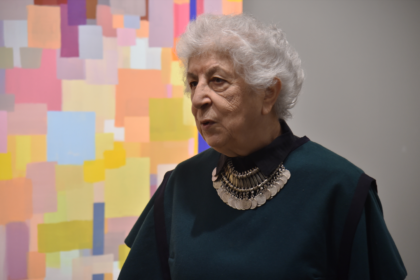
At Le Crédac, another art center, located in a former factory in the Parisian suburb of Ivry sur Seine, artist designer Pierre Charpin and painter Nathalie Du Pasquier’s two person exhibition “Andiamo” took over the ample spaces with a series of brightly colored paintings, installations, and objects. At first glance, the impulse to bring together the work of Charpin and Du Pasquier seemed incongruous: While Du Pasquier is well known in art circles and exhibits her paintings in well-established galleries around the world, Charpin, who was raised in Ivry, is more known for designing objects for brands such as Alessi and Hay. However, the exhibition made it immediately clear that the two share a remarkably similar formal language: families of similar shapes and colors, and still life like arrangements that recur throughout most of the pairings of paintings and 3D objects on view here. The presentation was didactics free, but the duo left a series of written clues to guide the viewer: A set of right-angled chairs (Charpin) and paintings of chairs (Du Pasquier), for instance, was accompanied by a plaque reading “Instruction Civique” (Civics Class), while a more asymmetrical, unruly set of paintings and drawings by both artists was labeled “Cultura populare” (Popular Culture), providing a sort of institutional, if cheeky, lens through which to view an otherwise abstract set of works.
Farther south, in Brétigny-sur-Orge, is CAC Brétigny, an art center founded in the 1990s whose institutional history includes the directorships of Pierre Bal-Blanc (Documenta 14) and Céline Poulin (Frac Île-de-France) and which is now led by curator Marion Vasseur Raluy. On view was the work of Paris- and New York–based artist Mona Varichon, presented in dialogue with the artist Malak El Zanaty Varichon, who happens to be her mother. Temporarily relegated to an off-site venue (the art center building is closed for renovations through 2028), the show is a collaboration between two artists whose lives are closely interlinked. Trained as a sociologist, Mona worked as an archivist for artists including Laura Owens and Diana Thater while studying in Los Angeles, while also producing video work that has gone on to be exhibited internationally, while Malak worked in the education department at the Centre Pompidou, where she led workshops for schoolchildren for over twenty years while developing her own practice that included paintings, collages, and photographs.


Titled “Lettres du quotidien Extraits, débuts, jeux, traces” (Everyday Letters Excerpts, Beginnings, Games, Traces), the exhibition highlighted the tension that exists between the products of the art world’s increasing professionalization and so-called amateur practices. Mona’s archival impulse has led her to approach her mother’s work through that lens, treating ephemera exchanged between mother and daughter as a subject of this show. Indeed, both Mona’s and Malak’s work is steeped in the quotidian: Here, art documents daily life, eschewing hierarchies between the personal (drawing filled written correspondence between mother and daughter, painted bathing scenes); the professional (photographs of Mona’s mother at work, collages spliced together from children’s drawings); and the political (photographs of protest signs, recordings of politically inflected speeches from public events attended by Mona). The latter, a newly commissioned video work by Mona titled Preuves sonores 2021–2026 (Et vous n’en voyez que les préludes) [Sonic Evidence, 2021–2026 (You’re Only Seeing Half, the Preludes)], 2026, provides a kind of closing statement to the show. The video featured audio recordings of political and art world speeches witnessed by the artist, including imam Khalid Latif’s invocation at New York mayor Zohran Mamdani’s inauguration and the director of a major French public museum’s (uncalled for) ode to private arts funding, delivered while announcing an art prize in Paris.

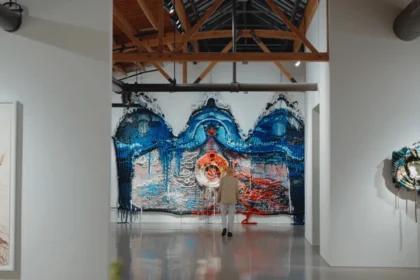
Located on the campus of the Université de Paris Cité in southern Paris is Bétonsalon, an art center recognized for its consistently excellent programming. Here, French artist Jean-Alain Corre is presenting “Hibou TV Show,” a large scale installation that transforms the art center into a public access television set populated by a cast of fellow artists, university students, staffers, academics, DJs, and writers. The feeling is one of irony and humor, with the set composed of found materials including pizza boxes, fabrics, an oversize Pink Panther papier mâché mask, and an unhinged looking figure named Jeanne who guards the entrance. The show’s first recording included Paris-based gallerist Valeria Cetraro as the host, with writer Gaëlle Obiégly (who cowrote the show’s script), critics François Aubart, Franck Balland, Liza Maignan, and Corre himself, disguised as a character identified as “Pink Panther/Tony Conrad,” as guests; when I walked in during the opening, a new recording from the previous evening was playing on flatscreens. A clear satire of the talk show genre, the conversations felt improvised and off the wall.

The entire program also aims to curry nostalgia around the bygone histories of artist led public access television, a genre first developed in the United States in the 1970s via artist collectives such as Deedee Halleck’s Paper Tiger Television (currently showing across the Channel at Goldsmiths CCA, perhaps indicating a wider renewed interest in this history). Here at Bétonsalon, the TV set will be activated with a program of talks, performances, and book launches, to be recorded and live streamed on Twitch over the course of the exhibition’s run. By my count, over a dozen participants are directly involved (and credited for their work in the accompanying handout), making this a truly collective enterprise.